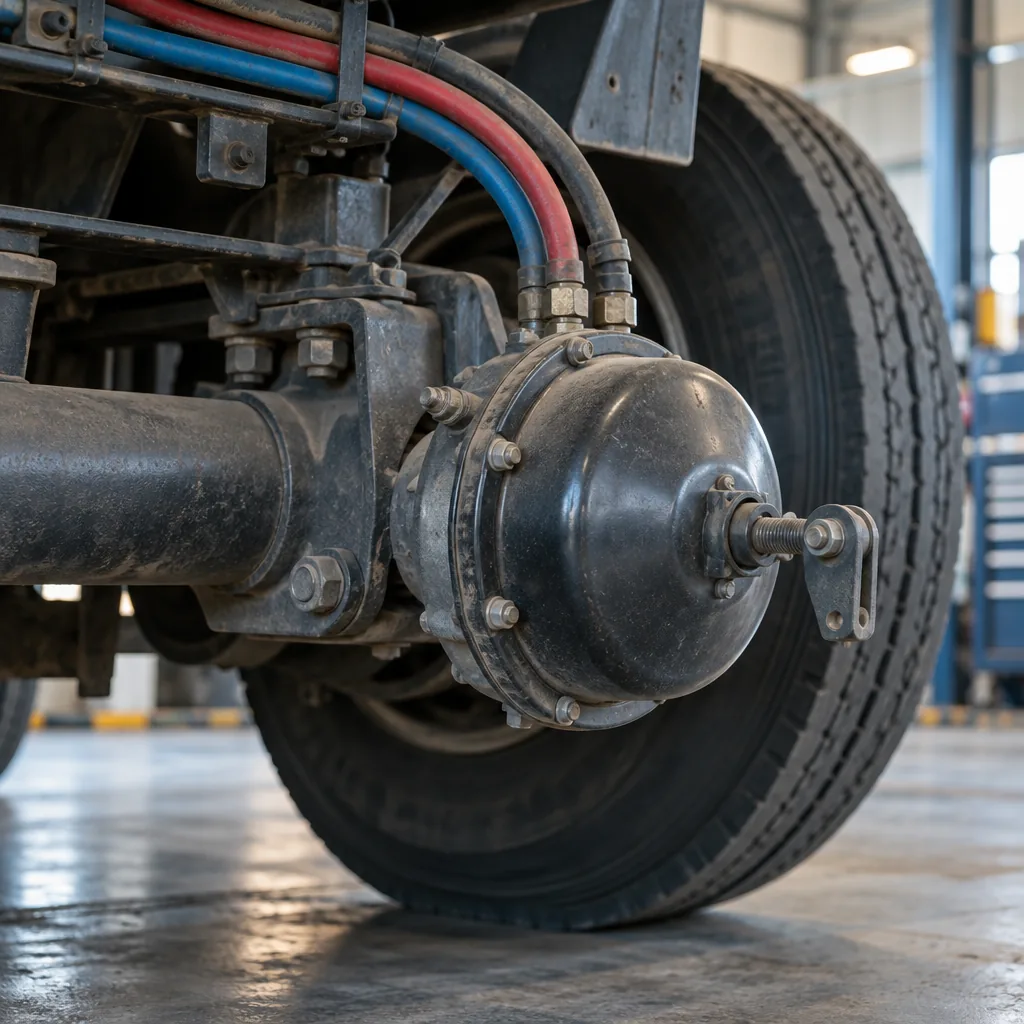
How to use this test: Choose the best answer for each question. The correct choice highlights green and the explanation appears immediately. There is no time limit. If you get one wrong, this browser quietly remembers it (never sent anywhere) so you can revisit it later from
My Missed Questions.
Question 1 of 65
What does the air compressor governor control?
Correct answer: A. When the air compressor pumps air into the air storage tanks
Why: Governor controls cut-in (pump on) and cut-out (pump off) pressures, typically 100/125 psi.
Question 2 of 65
Air brake systems combine three different braking systems. They are:
Correct answer: A. Service, parking, and emergency brakes
Why: Service brakes: foot pedal. Parking brake: yellow knob. Emergency: parking system used in failure.
Question 3 of 65
What does the safety valve in the air compressor or supply tank protect against?
Correct answer: A. Too much pressure in the air system
Why: Safety relief valve typically opens at 150 psi to protect tanks.
Question 4 of 65
When the brake pedal is pressed, air pressure to the brake chambers:
Correct answer: A. Increases, applying force to the slack adjusters and S-cams
Why: Pressure rises in chambers, pushing rods that rotate slack adjusters and S-cams to apply brakes.
Question 5 of 65
When should you drain air tanks?
Correct answer: A. At the end of each day to remove water and oil
Why: Daily draining prevents corrosion and brake freeze-up.
Question 6 of 65
How much pressure should be lost in one minute with the engine off and brakes released?
Correct answer: A. No more than 2 psi (single) or 3 psi (combination)
Why: Static leak: ≤2 psi/min single, ≤3 psi/min combo. Section 5.1.13.
Question 7 of 65
How much pressure should be lost in one minute with the engine off and brakes applied (combination)?
Correct answer: A. No more than 4 psi
Why: Applied leakage limit: 3 psi single, 4 psi combination per minute.
Question 8 of 65
At what air pressure should the low-pressure warning device activate?
Correct answer: A. Below 60 psi
Why: Low-air warning must come on before pressure falls below 60 psi.
Question 9 of 65
At what pressure does the spring brake (parking) typically apply automatically?
Correct answer: A. Between 20 and 45 psi
Why: Springs in spring-brake chambers apply when air falls into the 20–45 psi range.
Question 10 of 65
What is the proper way to test the low-air warning?
Correct answer: A. Build pressure, shut off engine, fan brakes — warning must come on by 60 psi
Why: Pump pedal repeatedly to lower pressure; warning device must activate before 60 psi.
Question 11 of 65
When you make a normal stop with air brakes, you should:
Correct answer: A. Push the pedal down with steady pressure to slow smoothly
Why: Smooth steady application; release as you stop.
Question 12 of 65
Why must air tanks be drained?
Correct answer: A. To remove condensation that can freeze valves and lines
Why: Water and compressor oil collect at tank bottoms; if not drained they corrode tanks and freeze brakes.
Question 13 of 65
What does an "alcohol evaporator" do in the air system?
Correct answer: A. Reduces risk of ice in air brake valves in cold weather
Why: Alcohol evaporator vaporizes alcohol into the air system to inhibit ice.
Question 14 of 65
How is the parking brake applied on a vehicle with spring brakes?
Correct answer: A. Pull out the yellow diamond-shaped knob
Why: Yellow diamond: tractor parking. Red eight-sided: trailer air supply.
Question 15 of 65
What can keep spring brakes from applying when air pressure drops?
Correct answer: A. Caged or broken springs
Why: If springs are caged (manually released) or broken, the brakes cannot apply.
Question 16 of 65
Modulating control valves are used to:
Correct answer: A. Apply spring brakes gradually using a lever
Why: Some vehicles have a modulating valve to gradually apply spring brakes.
Question 17 of 65
ABS on air brake vehicles requires:
Correct answer: A. A yellow malfunction lamp on the dash
Why: Yellow ABS warning lamp on tractors; trailers have a yellow lamp on the left side.
Question 18 of 65
How can you test that ABS is working on a tractor?
Correct answer: A. Turn the key on; the yellow lamp should light briefly then go out
Why: Self-test illuminates lamp briefly. If it stays on, ABS has a fault.
Question 19 of 65
What should you do if the low-air warning comes on while driving?
Correct answer: A. Stop safely as soon as possible and find the cause
Why: Once warning sounds, brakes can fail with little additional pressure loss — stop now.
Question 20 of 65
Why use the parking brake any time you leave the vehicle?
Correct answer: A. To prevent rollaway
Why: Parking brake must be set whenever you leave the vehicle.
Question 21 of 65
Total stopping distance with air brakes is longer because:
Correct answer: A. Brake lag adds about 0.5 seconds (32 feet at 55 mph) compared to hydraulic
Why: Brake lag — time for air to travel through lines — adds distance.
Question 22 of 65
How are the brakes applied on the trailer using a hand-control valve?
Correct answer: A. Independently of the foot brake — should not be used for parking
Why: Hand valve applies trailer brakes only and should not be used for parking.
Question 23 of 65
Why should you never use the trailer hand valve to hold a parked vehicle?
Correct answer: A. Air may leak out, releasing the brakes
Why: Service brakes leak; only spring/parking brakes hold reliably.
Question 24 of 65
Air braking takes more time than hydraulic braking because:
Correct answer: A. Air must flow through lines to brake chambers
Why: Lag = time for air to travel and build pressure at chambers.
Question 25 of 65
What is the proper procedure to test air brake leakage on a combination vehicle?
Correct answer: A. Charge to governor cut-out, off engine, release brakes 1 min, apply brakes 1 min
Why: Static and applied leakage tests done with engine off, parking brake released and applied.
Question 26 of 65
Stab braking on vehicles without ABS is:
Correct answer: A. Apply brakes fully, release when wheels lock, reapply when wheels start rolling
Why: Stab braking provides emergency stopping without losing control.
Question 27 of 65
Brake fade results from:
Correct answer: A. Heat build-up and reduced friction
Why: Excessive heat reduces friction between linings and drums.
Question 28 of 65
Why are slack adjusters checked?
Correct answer: A. To ensure brakes are within proper adjustment for safe stopping
Why: Out-of-adjustment slack adjusters are a leading cause of brake failure.
Question 29 of 65
Manual slack adjusters should be:
Correct answer: A. Adjusted by a qualified mechanic only when out of adjustment
Why: FMCSA requires only qualified mechanics; even with manual ones drivers usually only inspect.
Question 30 of 65
Pushrod travel beyond legal limits indicates:
Correct answer: A. Brakes need adjustment
Why: Excessive stroke = out of adjustment.
Question 31 of 65
How do you know if the front brake limiting valve is in the "wet" or "dry" position?
Correct answer: A. Some older trucks have a switch — set "dry" for normal roads, "slippery" for slick (now generally removed)
Why: Older vehicles had this switch; modern trucks no longer use front brake limiting valves.
Question 32 of 65
What is a dual air brake system?
Correct answer: A. Two separate air brake systems sharing one set of controls
Why: One system operates rear axles, the other front axle and trailer (or vice versa).
Question 33 of 65
How can you tell if your dual brake system has a leak in one circuit?
Correct answer: A. Low-air warning activates and one system loses pressure
Why: Each circuit has its own gauge; one will fall.
Question 34 of 65
What is the safe operating range for air pressure?
Correct answer: A. About 100 to 125 psi
Why: Governor cut-in/out typically 100/125 psi.
Question 35 of 65
Foundation brakes use which mechanism on most trucks?
Correct answer: A. S-cam drum brakes
Why: S-cam drum brakes are the most common foundation brake on heavy trucks.
Question 36 of 65
Wedge brakes are:
Correct answer: A. A type of drum brake using a wedge between brake shoes
Why: Wedge brakes are less common but appear on some heavy vehicles.
Question 37 of 65
What are the air brake test steps before driving (in order)?
Correct answer: A. Static leak, applied leak, low-air warning, spring brake activation
Why: AAMVA Section 5.3.10 lists the seven-step in-cab brake check.
Question 38 of 65
How is the trailer air supply controlled?
Correct answer: A. Red eight-sided knob on dashboard
Why: Red knob: pull to charge trailer (out=disconnect, in=charged).
Question 39 of 65
When connecting a trailer, the order is:
Correct answer: A. Connect emergency line first, then service line, then push in red knob
Why: Emergency (supply) connects first to charge the trailer.
Question 40 of 65
When uncoupling, you must:
Correct answer: A. Pull out the red knob to apply trailer brakes
Why: Red knob OUT applies trailer parking brakes before disconnecting.
Question 41 of 65
What is the proper procedure to recover from an air-brake skid?
Correct answer: A. Release brakes, countersteer toward intended path
Why: Release brakes to allow steering, then countersteer.
Question 42 of 65
What is brake lag at 55 mph approximately?
Correct answer: A. 32 feet
Why: About 32 ft from the time you press the pedal until brakes apply.
Question 43 of 65
You can test trailer service brakes by:
Correct answer: A. Pulling forward at 5 mph and applying the trailer hand valve
Why: Hand valve at low speed checks trailer service-brake function.
Question 44 of 65
Which of these is true about modulating valves?
Correct answer: A. They allow gradual application of spring brakes
Why: Modulating spring-brake control valves allow proportional application.
Question 45 of 65
When you press the brake pedal, more pressure equals:
Correct answer: A. More braking force
Why: Greater pedal force => higher pressure to brake chambers => more force.
Question 46 of 65
What does the air dryer do?
Correct answer: A. Removes moisture from compressed air before it enters the tanks
Why: Air dryer removes water and oil before air enters the system.
Question 47 of 65
Why should air tanks have separate compartments or several tanks?
Correct answer: A. So a leak in one part does not lose the entire system
Why: Multi-tank systems isolate failures.
Question 48 of 65
You may legally drive a vehicle with the low-air warning device on if:
Correct answer: A. Never — stop immediately
Why: Low-air warning means stop and fix before continuing.
Question 49 of 65
What is "air brake fade"?
Correct answer: A. Loss of braking effectiveness due to overheated drums
Why: Heat-induced fade: drums and shoes lose friction.
Question 50 of 65
What is the maximum pushrod stroke for a standard size 30 chamber on a long stroke?
Correct answer: A. 2.5 inches
Why: Long-stroke 30 chambers: 2.5" maximum stroke per FMCSA inspection criteria.
Question 51 of 65
What pressure is held in the trailer air tank when the trailer is parked and disconnected?
Correct answer: A. Whatever pressure existed when uncoupled, holding spring brakes off until it leaks down
Why: When the supply line vents, spring brakes automatically apply.
Question 52 of 65
Why is it important to test the spring brakes?
Correct answer: A. Confirm they hold the vehicle and apply automatically when air is lost
Why: Brake test step: with air drained, spring brakes must apply.
Question 53 of 65
When the trailer breaks away from the tractor, the trailer brakes:
Correct answer: A. Apply automatically when air supply is lost
Why: Loss of supply line pressure causes spring/relay valve to apply trailer brakes.
Question 54 of 65
How does a tractor protection valve protect the tractor?
Correct answer: A. Closes at low pressure to keep air in tractor system if trailer breaks away
Why: Closes around 20–45 psi, isolating tractor air from a damaged trailer.
Question 55 of 65
When may you remove the wheel chocks?
Correct answer: A. After parking brake is set
Why: Set parking brake before removing chocks; chock before releasing parking brake.
Question 56 of 65
How often should the air brake system be inspected?
Correct answer: A. Pre-trip and en-route per federal rules
Why: Pre-trip and en-route inspections are mandatory.
Question 57 of 65
What is the function of the spring brakes?
Correct answer: A. Apply parking and emergency braking using mechanical spring force
Why: Powerful springs apply when air is released or lost.
Question 58 of 65
Which is true about ABS during normal stops?
Correct answer: A. Brake the same as you always have, ABS only intervenes if wheels lock
Why: No special technique required for normal stops; ABS works automatically.
Question 59 of 65
How can you tell when ABS is active?
Correct answer: A. You may feel pulsation in pedal or hear a noise
Why: Pulsing pedal/clicking noise indicates ABS modulation.
Question 60 of 65
If your ABS warning light stays on, you should:
Correct answer: A. Continue driving carefully and have it serviced — vehicle still has normal brakes
Why: Vehicle retains normal braking; arrange repair as soon as practical.
Question 61 of 65
What is the function of a quick-release valve?
Correct answer: A. Allows brakes to release quickly when pedal is released
Why: Quick-release valves vent brake-chamber air locally for fast release.
Question 62 of 65
What is the function of a relay valve?
Correct answer: A. Speeds up brake application/release on rear axles by using local air supply
Why: Relay valves reduce brake lag on long air lines.
Question 63 of 65
What is the function of the foot valve (treadle valve)?
Correct answer: A. Sends air to brake chambers in proportion to pedal pressure
Why: Foot valve modulates brake-chamber air based on pedal force.
Question 64 of 65
Which is part of an air-over-hydraulic brake system?
Correct answer: A. Air booster supplies force to a hydraulic master cylinder
Why: Air-over-hydraulic systems use air pressure to assist hydraulic brakes.
Question 65 of 65
What is "compounding" of brakes?
Correct answer: A. Applying spring brakes while service brakes are also applied — can damage system
Why: Pressing the pedal with parking brakes already applied compounds force and can damage components.