Home › Study Guide
The complete CDL study guide
Everything you need to know to pass the CDL knowledge tests on your first attempt — from how the federal CDL system works to how to approach test day. Read straight through, or jump to the section you need.
1. What is a CDL?
The Commercial Driver's License is a federally regulated credential that lets you operate commercial motor vehicles (CMVs) in the United States. CDLs are issued by individual states, but the rules for getting one come from the Federal Motor Carrier Safety Administration (FMCSA). The CDL system was created by the Commercial Motor Vehicle Safety Act of 1986 to set a common national standard so that a driver disqualified in one state cannot simply move and reapply somewhere else.
Every state's CDL handbook is built from the same model document — the AAMVA Model Commercial Driver License Manual, maintained by the American Association of Motor Vehicle Administrators on behalf of FMCSA. That means the questions on a Texas exam are very similar to the questions on a Vermont exam. The questions on this site are mapped chapter by chapter to that same manual.
2. CDL classes
There are three classes of CDL:
- Class A — Any combination of vehicles with a gross combination weight rating of 26,001 pounds or more, provided the towed unit is over 10,000 pounds. Tractor-trailers, doubles, triples, and tankers all fall here.
- Class B — A single vehicle of 26,001 pounds GVWR or more, or that vehicle towing one of 10,000 pounds or less. Straight trucks, dump trucks, large buses, and box trucks.
- Class C — A single vehicle or combination that does not meet Class A or B but is designed to carry 16 or more passengers (including the driver) or transport placarded hazardous materials.
3. CDL endorsements
Endorsements are added to your CDL to allow specific kinds of driving. Each endorsement requires its own knowledge exam, and some require additional skills tests or background checks.
| Code | Endorsement | What it allows |
|---|---|---|
| H | Hazardous Materials | Transport placardable amounts of hazmat. Requires TSA background check. |
| N | Tank Vehicle | Drive any tank with capacity of 1,000 gal aggregate or 119 gal individual. |
| P | Passenger | Drive vehicles designed for 16+ passengers including the driver. |
| S | School Bus | Drive a school bus. Requires P endorsement. |
| T | Doubles/Triples | Tow more than one trailer. |
| X | Tank + Hazmat | Combined N and H endorsement. |
4. The General Knowledge test
Every CDL applicant takes the General Knowledge exam regardless of class or endorsements. It covers safe vehicle inspection, basic control, shifting, communicating with other drivers, managing speed and space, seeing hazards, distracted and impaired driving, accident procedures, fires, and railroad crossings. Most states require you to answer 40 of 50 multiple-choice questions correctly — an 80% passing score. Take the General Knowledge practice test →
5. The Air Brakes test
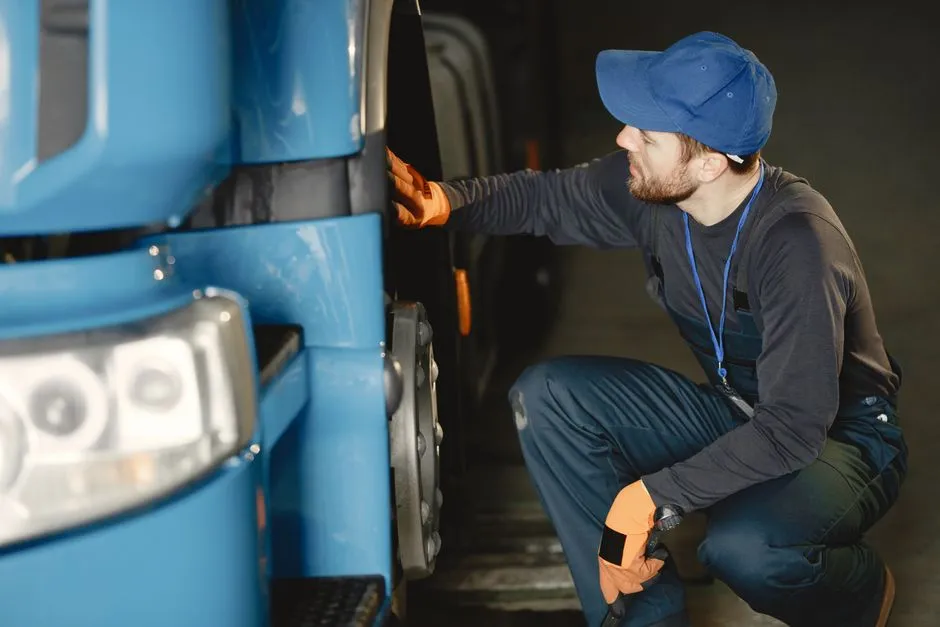
If your CMV uses a full air brake system or air-over-hydraulic brakes, you need the Air Brakes endorsement. Failing or skipping this test means you receive a Restriction L on your license, which prohibits you from operating any vehicle with full air brakes. The exam covers the seven-step in-cab brake check, dual air systems, brake fade, slack adjusters, ABS, spring brakes, and tractor protection valves. Take the Air Brakes practice test →
6. The Combination Vehicles test
This test is required for the Class A CDL. Topics include coupling and uncoupling, fifth-wheel inspection, off-tracking, rearward amplification, trailer skid prevention, and combination-vehicle air brakes. Take the Combination Vehicles practice test →
7. Hazardous Materials (Hazmat)
The Hazmat endorsement requires the most preparation of any CDL test, because it covers a body of regulation — 49 CFR Parts 100-185 — that runs into the thousands of pages. The exam itself focuses on hazard classes, shipping papers, placarding, loading and segregation, route planning, emergency procedures, security plans, and the Emergency Response Guidebook. You also have to undergo a TSA security threat assessment, which usually takes 30 to 60 days. Take the Hazmat practice test →
8. Tank Vehicle
The N endorsement covers liquid load handling: surge, slosh, baffled vs. smooth-bore tanks, outage, high center of gravity, and emergency procedures specific to bulk liquid transport. Tankers roll over more often than other CMVs, so the test puts heavy emphasis on speed control in turns and at intersections. Take the Tank Vehicle practice test →
9. Doubles & Triples
If you plan to pull more than one trailer, the T endorsement is required. The test covers converter dollies, coupling order, safety chains, pintle hooks, rearward amplification (the "crack the whip" effect), and the special handling characteristics of long combinations in wind and on grades. Take the Doubles & Triples practice test →
10. Passenger and School Bus
The P endorsement covers vehicles built for 16 or more passengers. Topics include vehicle inspection specific to buses, brake-door interlocks, prohibited practices, emergency exits, and behavior at railroad crossings. The S endorsement layers on the highest-risk areas of school bus operation: the danger zone, mirror use, child crossing procedures, the no-child-left rule, and evacuation drills. Take the Passenger practice test → · Take the School Bus practice test →
11. How to study
The most effective way to prepare for the CDL knowledge tests is to combine repetition with reading. Take a full practice test on this site for the endorsement you want. Note any questions you missed and read the explanation carefully. Then go to your state's official CDL handbook (linked from your state hub page) and read the chapter that covers the topic you missed. Take the practice test again two days later. By the third pass you will be at exam-ready accuracy.
Do not memorize answers in isolation. Examiners often re-word a question or change a single number to see whether you understand the underlying rule. The questions on this site are written to teach the rule, not just the right letter to choose.
12. On test day
Bring your identity documents, residency proof, and DOT medical certificate. Arrive 30 minutes early. The knowledge tests are usually computer-based at the DMV. You'll see one question at a time with multiple choice answers; most systems let you skip and come back. Read every word of the question — many trick questions hinge on the words "always," "never," "least," or "most." When in doubt, eliminate the obviously wrong answers first and then choose between the remaining options.